 |
 |
|

 |
 |
 |
 |
 |
 |
 |
 |
 |
 |
 |
 |
 |
 |
 |
 |
 |
 |
 |
 |
 |
 |
 |
 |
 |
 |
 |
 |
 |
 |
 |
 |
 |
 |
 |
 |
 |
 |
 |
 |
 |
 |
 |
 |
 |
 |
 |
 |
 |
 |
 |
 |
 |
 |
 |
 |
 |











 North to Alaska
The ones who did make a fortune were the merchants and profiteers who took advantage of the inexperienced miners, who they referred to as 'stampeders.' Long before the days of mass media, most of the 'get-rich-quick' miners knew virtually nothing about where they were going and the hardships that lay ahead of them. Pamphlets and newspapers contained little or no real information, but made outrageous claims of wealth, with riverbeds of gold just sitting there for the taking. Seattle served as water route and the gateway to the Yukon. Advertised as the 'outfitter of the gold fields,' merchants sold supplies, stocked ten feet high on storefront boardwalks.
Driven by dreams of unfathomable riches, the first stampeders arrived in Skagway and found themselves confronted by an inhospitable muddy settlement that was barely a collection of tents. They were also met by a swarm of con men, whose only interest was taking their money. The most infamous of the swindlers was 'Soapy' Smith and his gang of "bunco men." One of their schemes was operating a telegraph office, where a message could be sent anywhere in the world for a mere $5. What the stampeders didn't know was that there were no telegraph wires to or from Skagway.
The stampeders also faced a choice of two horrendous trails which had to be climbed before the freeze-up, then another 550 mile journey through the lake systems to the Yukon River's gold fields. The North West Mounted Police had created the "One Ton Law of 1898," requiring all miners entering Canada to carry a year's supply of food and equipment, equaling around 2,000 pounds. The 45-mile long White Pass Trail was promoted as a horse-packing trail and appeared easier than the Chilkoot Pass, where the miners had to carry supplies on their backs. The trail turned out to be even more difficult because of muddy bogs, massive boulders and steep rocky cliffs. Over 3,000 horses died along the way, and it was quickly dubbed the "Dead Horse Trail." It was obvious that there was need for a better form of transportation up the White Pass Trail. In 1897, three separate companies organized to build a railway from Skagway to Fort Selkirk, Yukon, 325 miles away. The project ran into some roadblocks due to corrupt local city officials and Soapy Smith. This ended when Smith was killed in a gunfight, and the White Pass & Yukon Route railway --- "the railway built of gold"--- began construction. Considered almost an impossible task, tens of thousands of men were challenged by a godless climate and brutal geography. Four-hundred and 50 tons of explosives were blasted though the solid granite mountainside. An innovative 3-foot gauge was used to save money, allowing for a tighter radius on curves and following the natural landscape.
Twenty-six months later, construction reached the 2,885-foot summit of White Pass, 20 miles away from Skagway. On July 6, 1899, the last spike was driven in Bennett, British Columbia. But the timing was bad. By then much of the gold rush fever had died down. The WP&YR continued, however, as an economic lifeline to the Yukon, but eventually shut-down in 1982 due to low mineral prices. But things would soon dramatically change. There was another kind of gold rush just around the bend. WELCOME ABOARD Tourism exploded in Alaska in the mid-eighties with the arrival of the cruise ship industry. The most popular voyage was through the Inside Passage along the shores of British Columbia and Southeastern Alaska. Tourists were stunned to find this pristine world of mammoth Ice Age glaciers, breathtaking mountain ranges, Native American culture, razor-cut fjords, historic Russian settlements, and spectacular wildlife. The Inside Passage quickly became the most popular domestic cruise destination in the U.S., and participants did it again and again. But soon they wanted more.
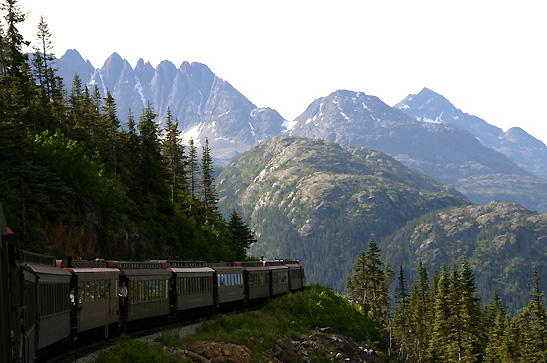
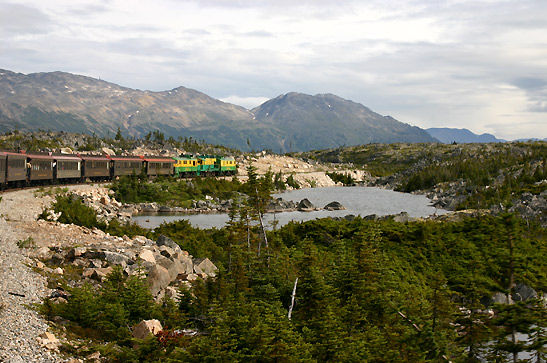
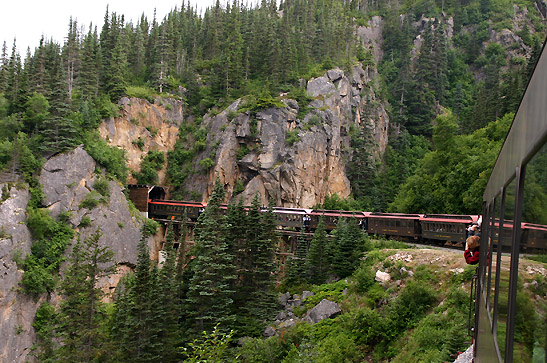
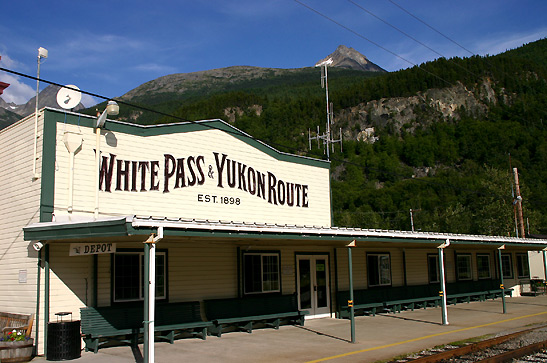
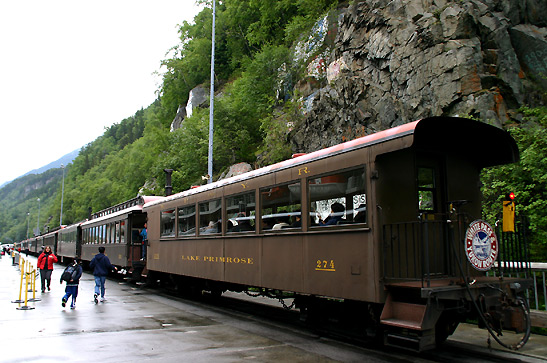
With numerous cruise ships stopping at Skagway, a re-creation journey on the White Pass & Yukon Route sounded like a perfect fit. The rails were laid right down to the docks, ideally positioned to sell a railroad ride through the mountains to the tourists. Billed as the "Scenic Railway of the World," the White Pass & Yukon Route reopened between Skagway and White Pass in 1988. As a heritage railway, tourist could now step back in time and experience the Klondike Gold Rush. Still using vintage parlor cars---three with wheelchair lifts--the WP&YR runs on its original narrow-gauge track, rising from sea level at Skagway to 2,885' at the White Pass summit in only 21 miles. Forget Disneyland. This is the real deal. With steep grades up to 3.9% and cliff-hanging turns of 16 degrees, the railroad seemingly hangs on the mountainside for most of the way to the summit. A series of wooden trestles skirt the landscape. A spectacular steel cantilever arches 215 feet above Dead Horse Gulch, once the highest railroad bridge in the world. It's a breathtaking piece of country with a stunning panorama of mountains, gorges, waterfalls, tunnels and historic sites. Period clad railroad men offer a folksy narration. A wood-burning stove keeps everyone warm. Today the White Pass & Yukon Route is Alaska's most popular shore excursion, and is an International Historic Civil Engineering Landmark, a designation shared with the Eiffel Tower, the Statue of Liberty and Panama Canal. For more information about the White Pass & Yukon Route, visit WPYR. |

 Let Ed know what you think about his traveling adventure.
Feedback for "Spokane, Pullman and the Palouse" Loved the Spokane article – my mom was born there and my grandparents are interred there. Haven't been back in decades. --- Nancy, Hawaii * * * * Feedback for "Norway's Fjords" Hi Ed. I was just reading your great story about traveling through the Norwegian countryside and the voyage along the coast - sounds amazing. I’ve been to Oslo, but definitely would like to return to Norway one day to explore exactly what you wrote about. Cheers, --- Sasha H. * * * * Feedback for "In Search of Movie Locations In the Land of Aloha" Mahalo for your article on Hawaii film locations. You should check out our new "The Hawaii Movie and Television Book" at: http://hawaiimtvbook.weebly.com/ --- Ed Rampell (Co-Author), Los Angeles, CA * * * * Hi! This is my first visit to your blog! We are a collection of volunteers and starting a new initiative in a community in the same niche. Your blog provided us useful information to work on. You have done a wonderful job! --- Christian Louboutin, U.K. * * * * Cool site. --- Donna Namaste', San Francisco, CA * * * * Great work as always. --- S. Wyatt, Seattle, WA * * * * Hr. (Danish for sir) Ed, Thanks so much for your article on Copenhagen, DK...loved it! Very well done actually I used to live in Christianshavn (just next to Christania) and Danish is my second language. You really did a quite grand job and pulled me ALL of the way into your analogy and experience from my other home. Just one detail that I thought might have been included.....the bakeries & cheese shops in the mornings in nearly every 5 or so blocks as they waft the incredible hypnotizing aromas of those amazing Danish specialties. I most especially and absolutely love the fact that you included the "hyggeligt" element...wonderful!! Another aspect of the Danish language that I have found interesting is that we only cuss to devil rather than the more typically religious icons and that love (elsker) is only very rarely used. All-in-all you have me totally on your team and I will always look forward to your future writing. Med venlig hilsen...(with kind regards). --- Breeze * * * * Hi Ed, Thank you for your article on the Cherokee Nation. I really appreciate the historical perspective and recognition of their contribution to American culture. --- Nora Weber, British Columbia * * * * Another cool issue. You da' man. One question: Is that Mark Lindsay on the front page? --- Brent, Seattle, WA * * * * This would be a fascinating place to visit. There is so much history within our reach that we don't often acknowledge in more than a token way. I am wondering if any individual or group has ever gone on a vision quest, or perhaps a memorial march, by retracing the path of the Trail of Tears? This would be a painful journey, for most, I imagine. --- Sandra, Seattle, WA
Osiyo! From Cherokee Nation Cultural Tourism: What a great description of Kauai! The pictures are awesome and I loved reading your travel report! Keep pushin' on! --- Lisa Long, Tulsa, OK * * * * I'm getting hungry again just reading your article! It's hot today and I could really use a shave ice right now. Hope you're having a great day! --- Melissa, Honolulu, HI * * * * Thanks so much for sharing! Wow. The beauty even from the few pictures here and your descriptions is breathtaking... I can't even imagine being there for real! The food looks and sounds exquisite, I'm not sure my kind of exquisite, but I do like to be adventurous on occasion :).Quite the story there. --- Emily, Boise, ID
Great pictures! --- Anna Harrison, Palmdale, CA * * * * Tough job, Ed! Thanks for sharing. --- Brenda Hughes, Richland, WA
Ed, Tim from the team of Jack and Tim - Star Clipper. Great trip. Always enjoy your postings. --- Tim & Jack, Washington DC * * * * Hi Ed, I really enjoyed your story on the Empress of the North. I was an Assistant Cruise Director aboard her in 2004, and you gave me a treasured walk down memory lane with her.You might know this, but if not .... you can cruise the Columbia again late this summer and early fall. The Empress' sister boat, the Queen of the West, was purchased by American Cruise lines and will offer a Columbia River itinerary which almost mirrors the one my Empress used to travel. Just thought you'd like to know. --- Paul Penta, 2004 Assistant Cruise Director, Empress of the North, Copperas Cove, TX
Ed, you are by far the most interesting of all the Boitanos. Your coverage is extensive and captivating. It's a real treat to read your blogs. Your article on the Baltic Sea Nations is no exception. But don't get me wrong, the other Boitanos have their own charm and perspective. Thanks for all your articles. I can see it's a work of art. I just now noticed your Dog Quotes --- what a great collection! Keep up the good work. Keep on sharing your travels! This is better than the more popular travelogues. --- Peter Paul, South Pasadena, CA
Hi Ed, How's life? Hope all's well in sunny Cal. Having just received the latest issue of the Traveling Boy newsletter I popped back over to your site to take a look around and came across this article which I had not previously read: www.travelingboy.com/archive-travel-ed-baltic.html Loved it! First of all, this is a part of the world that I absolutely adore so reading about it is always a pleasure. Secondly, I'm happy to see you crossing things off your Buck with such gusto! Myself, I have already been to Stockholm, Helsinki and Copenhagen, and Tallinn, St. Petersburg and Moscow are all on my Buck. After reading through the article I reminded once again why! One of my favourite lines in the piece is: "Granted, eight to twenty-fours in world-class cities like Helsinki and Tallinn hardly does them justice, but a sketch is always better than a blank canvas." So very true. I'll take a sketch over a blank canvas any day! Besides, sketches often lead to full-blown paintings anyway. Just wanted to let you know how much I enjoyed this story. Hope there are many more fun adventures awaiting you soon! Cheers, --- Ashley, Toronto
Thanks for a great trip, Ed - such a comfortable way to travel, particularly to several cities i knew very little about. I've had only one sea voyage - crossed to G.B. on the United States in the early 60s - no balconies, etc. on that ship, as she was prepared to be stripped down to carry troops in event of WWIII, but still luxurious in her own way. Bumped into a documentary recently on PBS re the old lady who is now docked in Philadelphia, I believe with peeling paint on her sides and funnels and of course the interior stripped and auctioned off of everything...periodic moves to rehabilitate her, but so costly people back off. She was the largest and fastest - still is. Her record was 3 days crossing - we did it in a little over 5 (cruise speed I guess!). They showed regular passengers like the Duke and Duchess of Windsor who happened to be on board when I was, as well as gazillions of stars who traveled on her. Charles Boyer was the only one on my crossing - we were alone in the library one time, but I didn't say anything. He looked immersed in his pursuit of a book. The Windsors were tiny little people, as was M. Boyer (and this comment from a 5'2" observer!). How's that for an ancient history lesson? Anyhow seeing the ship like she is now made me almost teary - surprised myself somehow. --- Brenda Hughes, Richland, WA * * * * I loved this article!! Kept me in rapt attention, felt like I explored part of the world myself ;) nice way to start my day, sounds altogether amazing and unforgettable! --- Emily, Boise, ID * * * * Great writing!! Reading, education and fabulous locations! All around WOWS! --- E Dava, Burbank, CA
What a wonderful assortment of travel destinations. I have always been drawn to islands, and as a Pacific Northwesterner, dream from time to time about settling in the San Juans someday (like a lot of us here visualize for ourselves). Hopefully, travel will occur before this particular dream comes to pass. I enjoy reading about the connections you have with the places you write about. I will visit that fishing village in Norway, someday, just because of the photograph. Who wouldn't, after seeing it. Thanks, Ed --- Sandee, Seattle, WA * * * * Another great edition! --- CG, Central California Coast * * * * Hi Ed, I sailed into Sooke on my way to port Ludlow from Portland, Oregon in my sailboat few years back. It was interesting port. The entry is snake like channel with local fisherman's local markers only to guide you into the port. --- Larry, Portland, OR
Wow. I want to go to Vietnam! It's beautiful! Those are amazing pictures! --- Archie, Pasadena, CA * * * * Kudos to Mark Twain. He knows how to honor a dog, and kudos to Cedric for all he was and still is and kudos to you for another edition of www.traveling boy.com. Peace and Love, --- Joel, Pasadena, CA * * * * Ed, I really enjoy your traveling adventures. Your stories are so well written and the photographs are amazing. Thank you for letting us in on your adventures. You bring the adventure to those of us who aren't able to go. Thank you. --- Cheryl, Pismo Beach, CA
Amazing story and pictures. To think that 40 years ago we were all terrified at the prospect of going there... what a difference a few decades makes. Fantastic article! --- Roger, Puyallup, WA
Thanks for your expert insight, Jeremy. Have you ever lived in New York? Don't tell me you are one of those tourists or former transplants. It's a very different experience when one lives here. Unlike Los Angeles, there really is a sense of community. New Yorkers love and care about their city... and, yes, their neighbors too. --- Lisa - New York, NY * * * * NY sucks. It's now nothing more than a Disneyland version of its former glory. It city filled with tourists and transplants, and no longer the center of the universe. The WEST is the best. Everyone is moivng to the Coast. Even NY fashion designers check out the LA street scene before launching their new designs. Plus no one in NY knows real pizza. Take a trip to Naples sometime and try the real thing. --- Jeremy - Los Angeles, CA * * * * The economic boom is what drove all the changes in New York. The mayors were in the right place at the right time, and to their credit, handled things well. It's easier to clean up the city and cut crime when you have more money to spend. The economic outlook for New York is bleak now with unemployment going up. Bloomberg already is short money and will be cutting services across the board. If things don't turn around, people may not be as friendly in a few years.The idea that New Yorkers are not nice is just a myth; people in L.A. are much more distant and shut-off. --- Michael, Native New Yorker * * * * I think that overall, Manhattan has become friendlier in the last few years, not sure why but don't think Giuliani or Dinkins can take credit. There was definitely a surge of NYC solidarity following 9/11, and Giuliani was extremely popular during that period. When he supported Bush so strongly in the election that followed, his popularity plummeted, though. Bloomberg has definitely done a good job with making a lot of bike lanes, blocking off large areas of what was previously street and putting tables and chairs for pedestrian use. Not sure how this economic downturn will affect local attitudes, though.... --- Sue, New York * * * * This is the best. Keep them coming.--- Paul Ash * * * * Ed, thanks for putting the Holland button on your site. By the way, your images really work! I opened the newsletter and was immediately tempted to click on an article. Love it. And also love the fact I can click on images in the articles to enlarge them. The short headline on the image makes me curious. Well done. --- Bianca Helderman * * * * Thanks Ed, for this delightful view of this wondrous city! The first time I traveled with a husband to NYC years ago, it was for an Orchestral Conductor's conference. We lived in Newfoundland at that time, so you can imagine my shock of coming from isolation to the big apple!My heart began beating as I looked out of my hotel window at the figures of humans below, scurrying like ants, I was up so high. It wasn't the height, rather, the invisible buzz, that urgently beckoned me to go outside! But when I reached the sidewalk, the rush of pedestrians made me wonder "where's the party?" Friendly? Yes! I lived in NYC for 5 years with a later husband and loved every minute! Being an artist, I could not relax enough to paint, so I took up acting and worked with "Children In Need" a charity, instead and partook of everything NY had to offer from opera and Off Broadway plays and such to ballet and wholistic healings....a city full of everything one could imagine! I truly love NYC and years later am grateful to live in a quieter area of California so I may relax and paint and do my healing work...going back only to visit my delightful haunts. There is nothing like NYC!. --- Yoka, Westlake Village, CA
Ed, Great issue. Well done. They keep getting better! --- Grace Conlee Micetich, San Diego, CA * * * * I loved all of the traveling news! It’s good to know you are still out there in the world. --- Judy Vincent
Ed, Thanks for getting me back on the Traveling Boy newsletter mailing list- I have missed it! I do believe we need contributions of the ‘road less traveled’ in the US for those of us whose feet never leave the ground… Ahhhh… the Badlands... Two Medicine in Glacier… the Lava tubes in central Oregon… my next destination wish: Monument Valley. --- Lorrie Sjoquist * * * * The photos and descriptions of this trip are wonderful. I love the idea of the slowed down pace of the train. Kind of a throwback to the "good old days." --- Larry Lombard, Puyallup, WA
I think you outdid yourself with the "Two Cities" article. I'm ashamed to admit that I knew so little about these two cities. I learned so much. Your article was jampacked with very interesting trivia. Surprised the Jazz greats and Walt Disney came from practically the same area. And those pictures --- especially the WWI museum --- what an incredible shot --- almost like out of somebody's Satyricon dream. Bravo! --- Rod, Glendale, CA
What a great article! --- Michelle, Torrance, California
Ed, The photos are spectacular. I can envision many a romantic novel
inspired by these majestic sceneries. Makes me want to do a little more research
on Norway. John Lenon must have been one of the converts when he wrote "Norwegian
Woods." * * * * Peter, Thanks for the kind words and taking the time to write. Indeed, Norway was paradise on earth, and I dream of returning again and again. You had a funny line about John Lennon being so inspired by the beauty of Norway that he composed the song, "Norwegian Wood." If I'm not mistaken, his reference to "Norwegian Wood" is just that: an inexpensive pine wood from Norway that was becoming popular in the UK. I did read somewhere, though, that "I Want to Hold Your Hand" was inspired by Norwegian fjord trek. Thanks again… and please keep writing. Ed
Ed, Reading Peter's implication that "Norwegian Wood" was based on a trip that John Lennon took to Norway led me to do some research. According to Paul McCartney at a press conference in Los Angeles: 'Peter Asher [brother of McCartney's then-girlfriend Jane Asher] had just done his room out in wood, and a lot of people were decorating their places in wood. Norwegian wood. It was pine, really, just cheap pine. But it's not as good a title, is it, "Cheap Pine"? It was a little parody, really, on those kind of girls who, when you'd get back to their flat, there would be a lot of Norwegian wood. It was completely imaginary from my point of view, but not from John's. It was based on an affair he had. She made him sleep in the bath and then, finally, in the last verse, I had this idea to set the Norwegian wood on fire as a revenge. She led him on and said, "You'd better sleep in the bath." And in our world, that meant the guy having some sort of revenge, so it meant burning the place down....' Of course, just cause it's on the 'net doesn't mean it's true. --- Jeff M, Tacoma, WA
Weird piece on Copenhagen (Cosy in Copenhaggen). Do you think now that Keefer’s in the slammer in Glendale for DWI he’s experiencing any hygge? I bet some of those jailbirds would like to see how touch he is. --- Adam S., Glendale CA
I loved your intro and the way you set up the article. It immediately set the tone of an action-paced adventure. I imagined Annette as a spy in a trenchcoat feeding you top secret information. I'm surprised you didn't get lost. Do they speak English over there? Are the street signs in English? Does a GPS work over there? I never heard of "hygge" but, like you, I think I've felt that sensation everytime the cold wind blows here in South Pasadena, CA. When I sit beside a warm fire, sipping my hot chocolate, I will remember this article. Thanks! --- Peter Paul, South Pasadena, CA
|


Stay tuned.
This site is designed and maintained by WYNK Marketing. Send all technical issues to: support@wynkmarketing.com
|
SKAGWAY - GATEWAY TO THE KLONDIKE By 1889 the whole world had heard of the Klondike Gold Rush and the gateway settlement of Skagway, Alaska. Originally spelled Skaguay, from the Tlingit name "Shgagwèi," meaning "a windy place with white caps on the water," its location on the neck of a panhandle, offered a narrow bridge into the Canadian interior. The naturalist John Muir likened the spectacle of the stampeders' arrival to a 'nest of ants taken into a strange country and stirred up by a stick.' Today Skagway retains the atmosphere of the gold rush days, an important component to Alaska's march to statehood. Preserved as a national park, its historical district features rustic boardwalks and about 100 buildings from the gold rush era, many filled with historic artifacts. Attractions include the Trail of '98 Museum, Gold Rush Cemetery and, of course, boardings on the iconic White Pass & Yukon Route railway. You can also visit Jeff Smith's Parlor, once the most famous of Soapy Smith's saloons. Make sure, though, you keep an eye on your pocketbook. Skagway's population of 862 doubles during the summer tourist season in order to serve the more than 900,000 visitors. For more information about Skagway, visit Skagway.com ALASKA'S MARCH TO STATEHOOD 11,000 - 6,000 YEARS AGO - Humans inhabit southeastern, Aleutian, Interior and northwestern Arctic Alaska. 6,000 YEARS AGO - Most recent migration from Siberia across the Bering Land Bridge. Earliest migration believed to have taken place up to 20,000 or more years ago. 1725 - Vitus Bering sent by Peter the Great to explore the North Pacific. 1743 - Russians begin concentrated hunting of sea otters, dubbed 'soft gold.' 1799 - Alexander Baranov establishes the Russian post now known as Old Sitka. 1848 - American whalers first enter the Arctic Ocean through the Bering Strait. 1867 - William Seward, secretary of state under President Andrew Johnson, negotiates the purchase of Alaska from Russia for $7.2 million. Dubbed 'Seward's folly,' the treated is signed in Sitka. 1878 - First salmon canneries at Klawock and Sitka. 1897 - 1900 - Klondike Gold Rush in Yukon Territory; heavy traffic through Alaska on the way to gold fields. 1902 - First oil production. Seventy-three years later construction begins on the Trans Alaska Pipeline. 1917 - Creation of Mount McKinley National Park. 1923 - President Warren Harding drive spike completing the Alaska Railroad. 1942 - Dutch Harbor is bombed, and Attu and Kiska Islands are occupied by Japanese forces. Alaska Highway is built-the first overland connection to the Lower 48. 1959 - Statehood is proclaimed on January 3, 1959. Excerpted from The Alaska Almanac (32nd edition), Alaska Northwest Books. (GACPC.com) 
|