 |
 |
|

 |
 |
 |
 |
 |
 |
 |
 |
 |
 |
 |
 |
 |
 |
 |
 |
 |
 |
 |
 |
 |
 |
 |
 |
 |
 |
 |
 |
 |
 |
 |
 |
 |
 |
 |
 |
 |
 |
 |
 |
 |
 |
 |
 |
 |
 |
 |
 |
 |
 |
 |
 |
 |
 |
 |
 |
 |











| Shouldering
Tradition by Gabriella Gafni
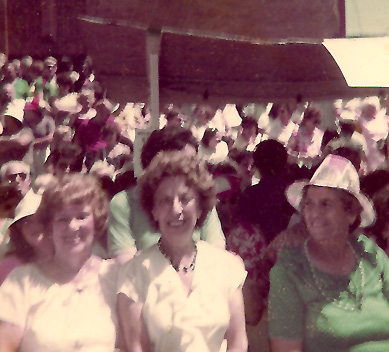
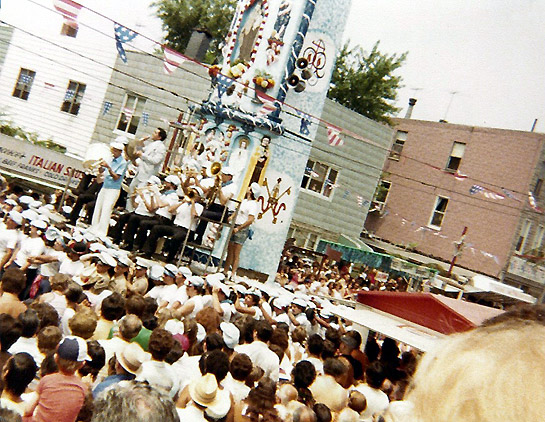 The Feast of Our Lady of Mt. Carmel (circa 1978) in full swing. In the crowd: Then New York Governor, Mario Cuomo and son, Andrew, now New York State Attorney General.
Like Italian food, the Giglio is the ultimate expression of culture, a monument to tradition. It is, in fact, a tower --- a five-story structure, weighing about ten-thousand pounds. One-hundred-twenty-five empowered faithful commit to the task of lifting or "dancing" the Giglio, literally carrying the tradition of their fathers, grandfathers, and great-grandfathers on their shoulders. The men proudly take their place in a hierarchy, from entry-level "Lifter" to "Lieutenant" who, after several years of lifting, takes charge of a thirty- to forty-member crew and passes along instructions from the "Capo" or "Head Lifter." The title of "Apprentice" goes to those who aspire to and demonstrate the potential of becoming "Capo." The word "Giglio" means "lily," signifying the ancient tribute-symbol to San Paolino of Nola, a priest whose selflessness and sacrifice for his townspeople earned him widespread praise. After he was taken into captivity by the Huns and released in the fifth century A.D., lilies were offered in his honor. The tradition continued after his death and, eventually, evolved into the carrying of these flowers on poles. Then, in the seventeenth century, celebratory music was added, along with decorative art on paper Mache spires. Centuries later, the lively rhythm of the Giglio (with its noted twelve-piece band) continuously set my grandmother's feet to dancing. Ever a devotee, even at age ninety, she looked up in awe, no doubt recollecting her father Rafaele's contributions to the Feast, his hand in the tower's construction, and his lyrical compositions for the occasion. "I've been coming here every year since I was two years old, in my mother's arms," my grandmother declared to my mother and me.
Though I had been to the Feast before, that particular July celebration was different --- perhaps because my grandmother decided that she would conduct the Giglio. For a time, she disappeared into the crowd. Given her penchant for exploration and adventure, we thought nothing of her absence. After a while, however, we became concerned and, somehow, made our way through the throng of celebrants to look for her. From my vantage point, the statue of San Paolino seemed to smile, in all of its glory, atop the Giglio. Suddenly, we saw her, Marie Tromba Mazzarese, nanogenarian, standing in the middle of North Eighth Street, in front of Our Lady of Mt. Carmel Church, directing the company of Giglio musicians. We admonished her that, if she didn't come away, she would, most likely, be overrun by the aluminum and paper Mache structure. She didn't hear or care. Waving her arms with astonishing precision and grace, she maintained her central position, right in front of everyone. In her own way, she was shouldering tradition, keeping alive the memory of those before her. Each of us carries an inner tribute to our ancestors
in some special way. Recollection is a conduit to the past and the future.
In remembering the Giglio tradition and what it signified to my maternal
ancestors, I hear their voices, returning to serenade me. |

 t was on a sweltering day in July, 2000 on the occasion of "The Feast
of Our Lady of Mt. Carmel" in Brooklyn, New York (the childhood home
of my mother and her family) when I noted the command, "Uaglió, a spal!"
(pronounced "Wal-Yo, ah sbahl"--- "young men, on your shoulders!").
These words, signaling the lift of the Giglio, echoed the inflections
of my Napolitano ancestors. The imperative mingled with aromas of brasciole
(a kind of sausage), opened clams on the half shell, zeppoles, and a
host of other Italian delicacies. What is a "Giglio" and what does it
have to do with food? Where Italians are concerned, everything
has to do with culinary indulgence. Failure to eat is the most egregious
omission, at once an act of self-deprivation and transgression of etiquette.
t was on a sweltering day in July, 2000 on the occasion of "The Feast
of Our Lady of Mt. Carmel" in Brooklyn, New York (the childhood home
of my mother and her family) when I noted the command, "Uaglió, a spal!"
(pronounced "Wal-Yo, ah sbahl"--- "young men, on your shoulders!").
These words, signaling the lift of the Giglio, echoed the inflections
of my Napolitano ancestors. The imperative mingled with aromas of brasciole
(a kind of sausage), opened clams on the half shell, zeppoles, and a
host of other Italian delicacies. What is a "Giglio" and what does it
have to do with food? Where Italians are concerned, everything
has to do with culinary indulgence. Failure to eat is the most egregious
omission, at once an act of self-deprivation and transgression of etiquette.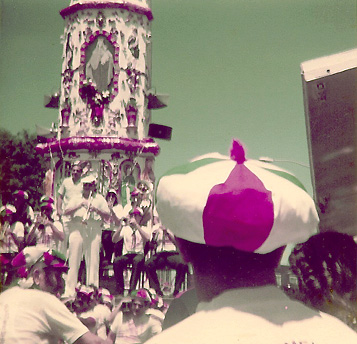


FEEDBACK FOR PATTI I enjoy your newsletters -and particularly Patti Nickell's article
about the 'Pudding Club' in the Cotswold's. An old friend of mine is taking
a holiday there this year and plans to try their Jam Roly Poly and Spotted Dick
- amongst many!
FEEDBACK FOR JULIO The way I read this article, you stayed at the "Breeze
and Waves". Do you have any pictures of the cottages, and would you recommend
to some first time visitors to Caramoan? Hi Richard, Breeze and Waves was still under construction when I stayed
there in Feb. 2010. It should be finished by now. You
can see pictures of the resort on this page. We got to stay in one of the
small cottages in the picture. I'll recommend it to budget travelers but you
might want to look at other options. We chose it because of its location right
by the beach. You can try other resorts in the Caramoan town proper (you have
to get a ride to get to the beach and the jump-off point to go island-hopping
but it's a relatively short distance). There are also two higher end resorts
located on a cove and very near the islands: Gota Village Resort (unfortunately
there is something wrong with their website right now) and its twin resort Hunongan
Cove. Caramoan is a relatively new tourism development so resorts are just now
being built. I should add that it might be good to go to Caramoan (and almost anywhere in the Philippines) during the dry season from December to May. June to November are the typhoon months and sometimes typhoons will still come during early December. Julio * * * * * Hi, I'm planning to go to Caramoan this coming May. Would you
know the number of Breeze and Waves Cottages? Thanks! Hi Ann, Breeze and Waves' phone number is 0908-2911072. Look for Freddie. Hope you have a grand time at Caramoan! Julio
FEEDBACK FOR WENDY For Nature's Playground: The South Island of New Zealand Hi Wendy, In winter, Heritage Heights Apts. now offers free shuttle service to and from Queenstown 24/7 to guests without cars. We own a 7-passenger 4-wd Toyota Highlander used specifically to taxi guests up and down the hill during winter months. We also run advance purchase winter promotions which include a 4-wd rental. If any of your readers head over this direction, I will enjoy extending Heritage Heights hospitality!! Cheers --- Ailey, Owner, Queenstown, NZ * * * * * New Zealand text and pix top drawer! Almost as good as making the trip. ( but one still wants to. . . ) Full of useful detail. Only trouble with the website: It's tough figuring out which feedback goes with which article, and the more there are, the tougher it gets! --- Ken W., Camarillo CA Thanks Ken..."álmost" is right, you really have to experience the South Island firsthand. Granted this piece is long, but still all I can think about is how much I left out! I agree abut the relevancy factor re the feedback--it can be confusing...sometimes I have a "Wait a minute...what?" moment myself. Thanks for writing, Wendy * * * * * Okay Wendy, from now on whenever you book your travel, please reserve space for me. I will carry your luggage, bring you cold drinks, massage your shoulders, and change the film in your camera (oops, I guess you don't have to do that anymore). Wonderful ideas and recommendations. Can you get to New Zealand from Boston in less than a week? --- Carl A., South Easton, MA Ha ha ha Carl, you're quite the comedian! But you'd be surprised how short that flight feels. I suspect Qantas isn't the only airline who's figured out that 3 movies, 2 full meals, lots of snacks and a complimentary travel pack (eye mask, warm socks and neck pillow) equals a quiet, well-behaved cabin. It really isn't bad. Just fly direct--pick the shortest flight w/ no lengthy layovers and you'll be fine. Re: signing on as my Super Sherpa...why not? I think you know I seldom travel in anything less than Party mode. There's just that pesky background check... Thanks for writing, Wendy For Excellence Riviera Cancun: Wendy, I truly enjoyed your info especially since we leave in a week to celebrate my 50th Birthday. Was it necessary to make reservations at the restaurants? Was there a dress code for the restaurants? What would you recommend not missing while there? Was the spa experience worth it? Did you travel away from the resort while there? Thanks, --- Kim P. Fuquay, Varina, NC Hi Kim. Sorry for the delay in responding...you had heavy competition with the holidays. Reservations at Excellence restaurants are not necessary and you will not find a wait. The dress code is basically no bathing suits and flip-flops...with a decided a mix of atmospheres. Mostly the open-air beachside spots are super casual, the rest slightly more formal. Truly, as long as you are clothed, I don't think you'd be turned away anywhere, though most people seemed to enjoy dressing up at night...I suspect more for their own pleasure than any sense of decorum. The spa experience was worth it, though my favorite part wasn't the actual massage. The precursor was a 45 min. or so rotation from sauna to a series of (kind of wild) water jets which was very different and very cool, not just for women. In its' entirety, and with the serenity of the beach/champagne/strawberries, it was memorable. We did not travel away from the hotel this trip, but the hotel is very helpful in arranging day excursions to fit your desires and you do not have to book these until you arrive. Have a great time! --- Wendy
FEEDBACK FOR NINO I enjoyed Nino's contribution, since we all read about the frightening
terrorist attack. Having travelled somewhat through India years ago, I am continually
impressed with this country and the gentle spiritual aspects of this nation.
Some day I look forward to going back. Nino has encouraged me. Thank you!
FEEDBACK FOR RUSH & CHUCK Dear Mr.s/counselors Brown and Koro, Thank you for a very informed and succinct article on motorcycle accidents and the law. It inspired me to think about getting a motorcycle, but not have an accident. But, if I do I am now well informed with the basics of what to do providing I do not perish in the accident. Any tips about that too? --- Unnamed
Dear Rush and Chuck, I wish I had read your article before our camping trip the Friday prior to President's Day. My wife and I were in a car accident on our way to a camp ground. We were "rear-ended" and the impact caused our car to crash into the car in front of us. The contents of the truck that we were riding scattered onto several lanes. It's a miracle our two dogs decided to stay inside the car. My wife and I were shaken up badly but despite the mess, I was still able to walk out of the car. I got the license plate of the driver in front of me but, to my surprise, after reviewing the little damage on his car, he then sped off. I didn't know you could do that! The driver who hit me from behind gave me his information and then he too left the scene without saying good 'bye. When the police arrived all I had to go by was the little information I had jotted down which I hope was truthful. What if it was bogus? What if I had written the plate number incorrectly? How would that affect my insurance? What if we were unconscious, who would have written down all that information? I do have one suggestion if you are injured in an accident. The police asked if my wife wanted an ambulance to bring her to the hospital but we declined the offer. I remembered when I rode an ambulance years ago that it was not a comfortable ride. I was strapped to the stretcher and there were all sorts of medical equipment dangling noisily above me. As long as you are able, it is a more relaxful ride inside a car. Besides, isn't there a fee for ambulance service? --- Dave S. of Pasadena, CA
|

This site is designed and maintained by WYNK Marketing. Send all technical issues to: support@wynkmarketing.com

|