Highway 49 Revisited
Exploring California's Gold Country By Ringo Boitano
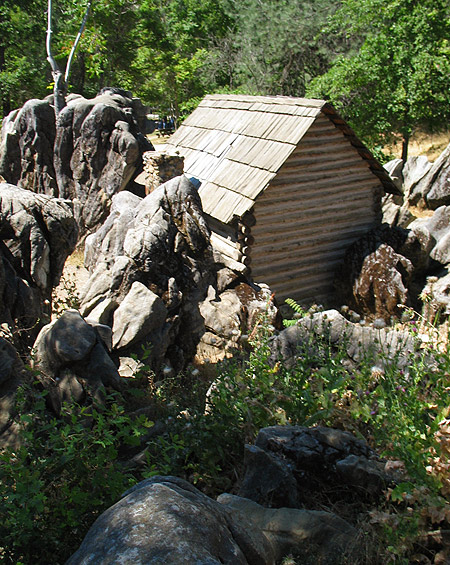
Courtesy: Marshall Gold Discovery
State Historic Park
There's Gold in Them Thar Hills
In the 1840s, the population of California
was only 14,000, but by 1850 more than 100,000 settlers and adventurers
had arrived from all over the world - and they came for one reason:
gold. James Marshall had discovered the first gold nugget at Sutter’s
Mill in El Dorado County, creating the largest gold rush in history.
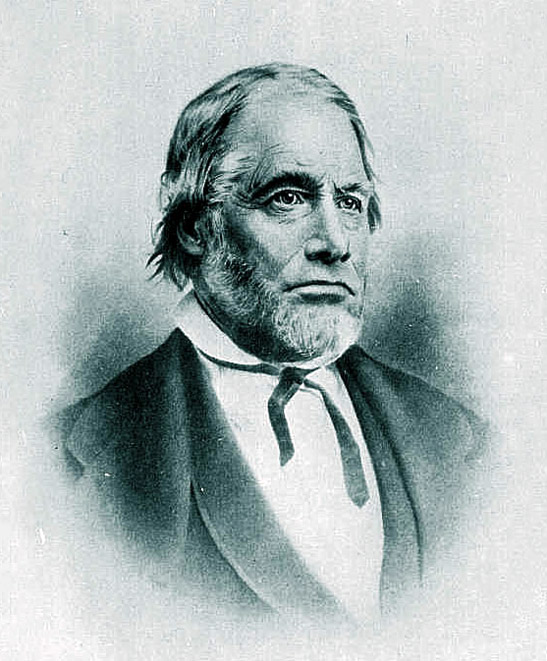
James Marshall, the Discoverer of Gold.
Courtesy: Marshall Gold Discovery State Historic Park
Adventurers poured into the area in search of quick
riches, creating a period in American history that has never been repeated.
Mexican miners called the area La Veta Madre (The Mother Lode), and
the locals called the new arrivals 49ers, due to their year of arrival.
Camps and towns sprang up wherever gold was found, and then were abandoned
when it ran out.
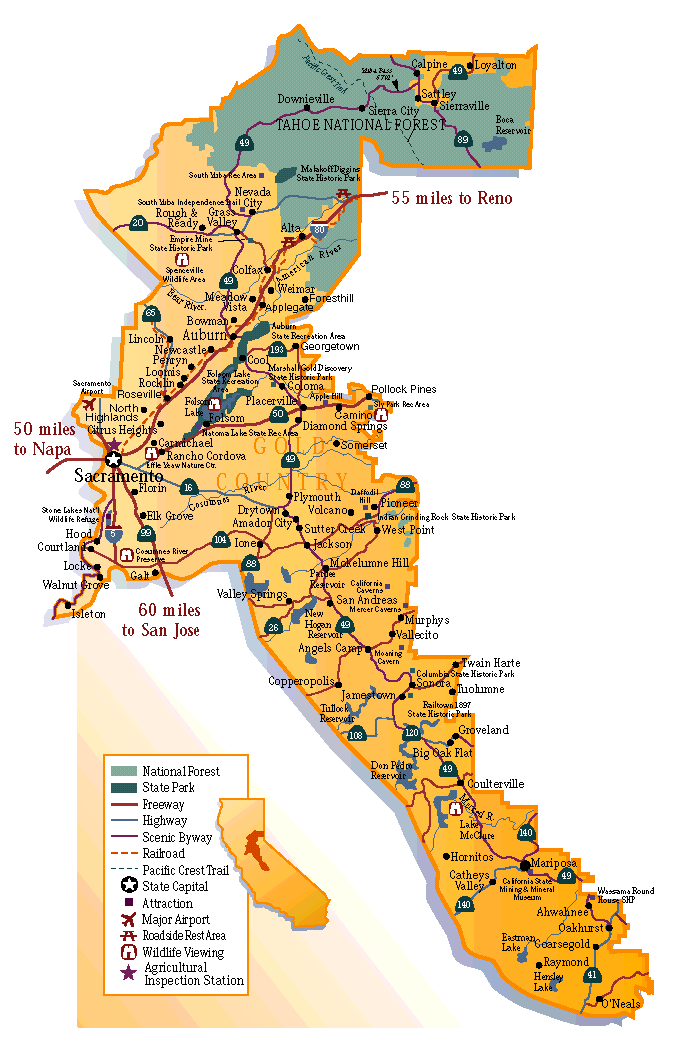
(Click on the map for enlargement)
Highway 49 Revisited
Today, visitors still flock from around the world to
California Gold Country to discover the area’s rich history. Reminders
of those glory days can be found everywhere along historic Highway 49,
which runs 321 miles along the Heritage Corridor and links many of the
19th century Mother Lode mining towns. The region extends from the sweeping
Sierra Nevada Foothills in the west to the spectacular mountains of
the High Sierra in the east. This is an area brimming with state historic
parks, like Marshall Gold Discovery State Historic Park and Columbia
State Historic Park, allowing visitors a look into the days of the Gold
Rush history. Almost 300 camps have vanished or are ghost towns in decay.
Some are just a stop at the side of the road, but if it is Gold Rush
history that you want – this is the place. On these back highways,
visitors will also find a wealth of charming small towns with restored
Victorian inns, boutiques, antique shops, and award-winning wineries.
Scenic wonders include pristine lakes and rivers; giant sequoias, pines,
cottonwoods, and oaks; and green hillsides, dotted with seasonal flow.
Gold Country South
Tuolumne County is the recreational and cultural center
of the Gold Country. Conveniently located near Yosemite National Park,
keep your eyes peeled when exploring the back roads, for a sign or plague
can easily be missed, introducing you to an area of countless wonders.
Jamestown
When you see the sign, “Jamestown, California -
Gateway to the Mother Lode!” you know you have arrived. Located
on Highway 108/49, this small gold rush town is your first stop when
visiting Tuolumne County. Main Street is lined with Victorian hotels,
saloons, restaurants, antique shops and galleries. The "old west"
atmosphere makes historic Jamestown the ideal place to introduce the
family to the heritage, charm and authenticity of this historical Sierra
Nevada foothill town.
Angels Camp
Angels Camp is nestled on scenic Highway 49, with a
history similar to that of many California Gold Rush towns. In 1848
Henry Angel, a shopkeeper from Rhode Island, opened a trading post.
Soon there were as many as 4,000 miners working the surface gold of
Angels. Today, Angels Camp's population is nearly 3,000, and the entire
town remains honeycombed with miles of mine tunnels. One of its most
popular attractions is Moaning Caverns, an immense limestone miracle
with a main cavern large enough to hold the Statue of Liberty, which
is open to the public.
Courtesy: Columbia State Historic
Park
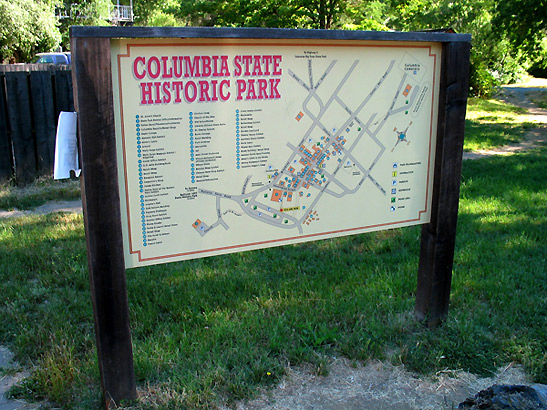
Columbia State Historic Park
Established in 1850, Columbia State Historic Park is
the best preserved of all California gold rush towns. Once known as
the "Gem of the Southern Mines,” over one-half billion dollars
in gold (at today's currency rate) between the 1850s and 1870s was mined
in the area. At that time it was the state’s second largest city.
Today it is a year-round getaway that offers a unique blend of museums,
displays, town tours, live theater, shops, restaurants and saloons.
No other location offers a better overview of California’s gold
rush history. This is an essential stop on your tour. Docents (trained
volunteers) appear in costumes throughout the park, and interpret life
in a California gold rush town with living history demonstrations, which
give visitors a greater appreciation and understanding of California's
early days. Popular events include the annual Columbia Diggin’s,
which is a re-creation of the "tent town" days of early Columbia.
Docents in costume and character perform various "scenes"
depicting life in the rough and ready days of the early 1850s. Gold
Rush Days are offered the second Saturday of each month. The park is
located three miles north of Sonora, off Highway 49.
Chinese Camp
During the mid-1850s, an estimated five thousand Chinese
immigrants from Canton lived in this area that was known by names like
Chinee, Chinese Diggins and eventually Chinese Camp. Like everyone else,
the Chinese came for the gold. Many had been driven away from other
camps, and settled here due to the openness of the early population
of Salvadorians, who accepted the outcast miners without problem. Others
then gravitated to the camp, feeling safe and comfortable among others
of their nationality. Chinese Camp is easy to find -- it's right on
Highway 49 about 5 miles south of Jamestown. Today it has less than
200 residents, but there is ample evidence of its colorful past. Much
of the camp, though, is in dissreappear and surrounded by barbed wire.
St. Xavier’s Catholic Church (circa 1855) and cemetery sits on a hill,
overlooking the town, and makes a great stop for photo opportunities.
Sonora
Known as the “Queen of the Southern Mines,”
this pristine city offers historic charm with many of its existing buildings
dating back to the 1800s. Even side streets are lined with Victorian
homes and old-fashioned gardens that hark back to the days of ‘49.
Mark Twain’s cabin, where he wrote "The Celebrated Jumping
Frog of Calaveras County" is located on Jackass Hill, just outside
of Sonora.
Feedback for Ringo
I love Ringo's piece on historic hotels. I once stayed
at the Laurentian in Montreal - is it still around, is it historic?
And then there was the Heups in Bismark.
It is interesting that two of your entries are in CANADA.
Brent, Seattle, WA
It's no mystery that you are great at what you do.
Sandee, Seattle, WA
* * * *
The Mystery on the Oasis pics are very funny!
Ramon, Kansas City, MO
* * * *
Ha ha ha ha ha...love your "schtick" Ringo!!
Dolly, Las Vegas, NV
Hello the travelling Boitano's hope you enjoy. Best
wishes.
My Irish roots understand terrible beauty. So do my
human roots. The concept has such a ring of truth to it, doesn't it?
Great article, Ringo. I hope to get to Ireland eventually, and thanks
for blazing the trail!
Sandeee Bleu, Seattle, WA
* * * *
No wonder I've been hearing all these wonderful stories
about Ireland. I used to think that it was just for Irish Americans
seeking their ancestral roots but your article seems to call out to
the non-Irish like me. Fascinating and intriguing.
Peter Paul, Pasadena, CA
Thanks for this great post wow... it's very wonderful.
Key Logger, New York
* * * *
Lets not forget that the Marriot Harbor Beach is within
walking distance to the world famous Elbo Room - Fort Lauderdale's oldest
bar.
Jeff, Fort Lauderdale, FL
* * * *
Jeff–
Thanks for taking the time
for the message and reminder. Indeed, I had a quick drink at the Elbo
Room. My trip to Ft. Lauderdale would not have been complete without
a visit to this historic institution.I have been reading about it for
years, and was not disappointed. It felt like a real local's hangout.
- Ringo
Ringo,
I
thoroughly enjoyed your article about Dick and Liz. I remember seeing
that article back in the heyday of Life Magazine.
To remember the "behind-the-scenes" stories
like that makes you genuine fan of the 60's. The famous couple's turbulent
relationship was just a precursor of today's headline-grabbing media
stars like Britney Spears and her colleagues. Life was simpler then.
The paparazzis still had some sense of decency. You "coulda"
been a good paparazzi. I say "coulda" because you kept this
to yourself all these many years.
Looking forward to other media trivia you can remember.
Peter Paul, South Pasadena, CA
Hey, Ringo –
Enjoyed your article on Antarctica --- cool photos,
too. One thing, you mentioned that Ushuaia in Argentina is considered
the most southern city in the world. I read that Chile lays claim to
that distinction, with Punta Arenas, the southernmost city in the world.
Mick, Greenbay, WI
* * * *
Mick –
Now that football season is
over --- I’ve often wondered what you Packer fans did in the off
season ---- it’s great that you took the time to visit TravelingBoy.
Great question, unlike my older brother, I adore all lamb products,
and Patagonian Lamb --- cooked in a restricted area at the restaurant
in an opened wood-fueled fire pit --- is amazing. The chef actually
uses an ax to carve it. Frankly, I found it superior to Norwegian fjord
lamb, Irish Burren lamb and even those much esteemed creatures down
in New Zealand. The crab in Ushuaia is the other thing to eat. Wait
a sec, you asked about Punta Arenas vs. Ushuaia as the furthermost city
in the world. Well, they both have little disclaimers re populations
--- you know, what’s a city, which one is a town, ect – so
better let Chile and Argentina brass it out. They seem to be able to
argue about any subject.
- Ringo
Three Musical Pilgrimages: Mozart, Grieg and Hendrix
Johann Chrysostom Wolfgang Amadeus Mozart (1756 - 1791)
could read and compose music, plus play the violin and piano, when he was
five years old. Born into a musical family in Salzburg, Austria (then the
Holy Roman Empire), he had a unique ability for imitating music, which first
became evident when he recited a musical piece by simply observing his father
conducting a lesson to his older sister. This led to a childhood on the
road, where the young prodigy performed before many of the royal courts
of Europe.
Treasures of Ireland: The Irish Goodbye (Dispatch
#20)
The Palladian Traveler brings to a close his 20-part
series on the Emerald Isle from an upscale restaurant in downtown Dublin
where he files his final dispatch and then quietly slips away.
Two "MUST SEE" Truly Spectacular Places
in Europe. Here's Why.
The Han Grotto and Culzean Castle. As the name
of my Traveling Boy feature is "Travel With a Difference," it's
important to me to always bring you offbeat and unusual tourist places around
the world you may not know about. These two fit that category to a T, and
they're absolutely worth a visit. One's in Scotland and one's in Belgium.
Culzean (pronounced CULLANE) Castle is located near Maybole, Carrick, on
the Ayrshire coast of Scotland.
Highway 49 Revisited: Exploring California's
Gold Country
In the 1840s, the population of California was only
14,000, but by 1850 more than 100,000 settlers and adventurers had arrived
from all over the world – and they came for one reason: gold. James
Marshall had discovered the first gold nugget at Sutter’s Mill in El
Dorado County, creating the largest gold rush in history.
Lake Charles’ Family-Size Low-Key Mardi Gras
The Southwest Louisiana Mardi Gras in Lake Charles,
the second largest in Louisiana, does not need parents there to avert their
children’s eyes. This is family entertainment and children are very
much part of it. The main office of the Lake Charles CVB has costumes from
last year’s Mardi Gras but it also has figures to fascinate little
ones from country boys fishing for their dinner to alligators who have already
fed and are rubbing their stomachs.
Puerto Vallarta: Magic and Mayhem on the Malecon
So I heard that you could spend from dawn to dusk on
the Malecon in Puerto Vallarta, Mexico and never get bored and I thought,
"Okay, I'm up for that challenge." Well, maybe not the dawn part
– I'm not a morning person – so I had no problem leaving those
early hours to the joggers and those seeking an early start to catch their
red snapper for dinner.