 |
 |
|

 |
 |
 |
 |
 |
 |
 |
 |
 |
 |
 |
 |
 |
 |
 |
 |
 |
 |
 |
 |
 |
 |
 |
 |
 |
 |
 |
 |
 |
 |
 |
 |
 |
 |
 |
 |
 |
 |
 |
 |
 |
 |
 |
 |
 |
 |
 |
 |
 |
 |
 |
 |
 |
 |
 |
 |
 |








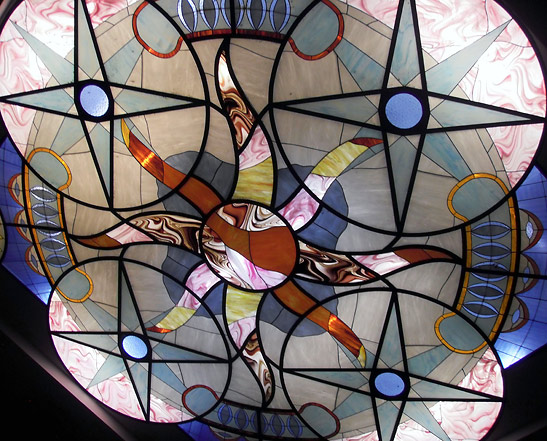 Ceiling inside Hacienda Tres Rios Mayan Outtakes:
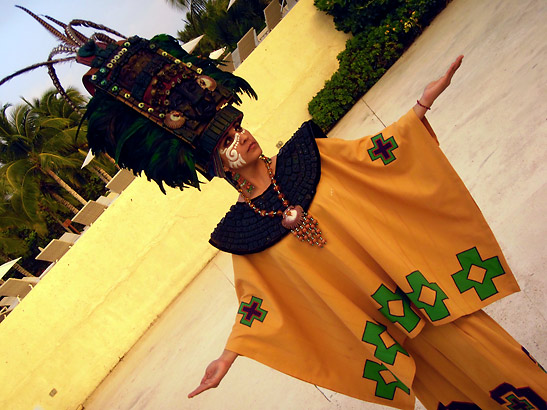
Several others have apparently done the same. Bottles are beginning to fill the pyramid, a makeshift recycling vessel as part of a new art project by Xavier de Maria y Campos. The structure, Piramide del Pensamiento Positivo (The Pyramid of Positive Thinking), will eventually be constructed in Aldea Zama in the heart of Tulum, Mexico. For now, people are encouraged to write down their positive thoughts, put them in recyclable plastic bottles and contribute them to a local receptacle. The bottles will be collected and placed into the main pyramid. The final pyramid will be 12 meters high and will be able to host 700,000 positive thoughts. The artist envisions the pyramid as "an incubator that will gestate a synergy among those of us who have contributed their positive thoughts inside a bottle to be reused in the construction of the pyramid." Of course, no apocalyptic 2012 conspiracy theories are needed here. The Maya themselves have never even heard of such things anyway, so this just puts me in a more positive mood. After 2500 years, the Maya are still building pyramids. As a result, I write down another positive thought and drop another bottle into the receptacle. Outside in the courtyard, in the punishing Riviera Maya heat, the dancers do their thing. I remain positive. That synergy Xavier talks about seems to already propel me through the blazing Yucatan humidity as I continue to occupy a few interstices of the immediate surroundings. The Maya influences emerge everywhere.
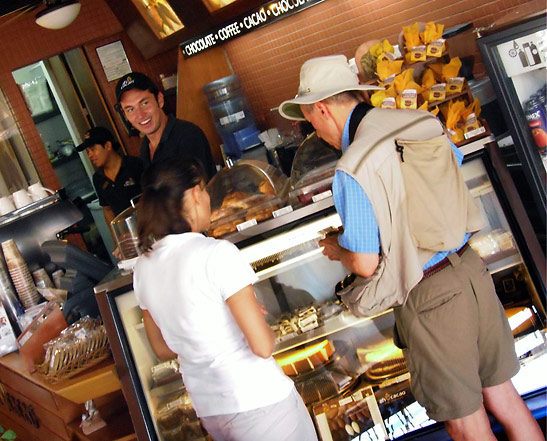
How Now Brown Cacao In one sense, just as the Maya beat the Hindus to the punch in discovering the zero, they also claim to be the originators of chocolate. Ancient Maya and Olmec civilizations established the first plantations around three thousand years ago, long before the Europeans discovered chocolate. Cacao is a Maya word, I learn, while escaping the heat of Playa del Carmen. Just off 5th Avenue, sits Ah Cacao, a celebrated chocolate and coffee store. Folks sit at tables crouched over laptop machines, tourists are sampling cinnamon chocolate ice cream. I observe chocolate soap, bags of cacao beans, body oils, iced mochas and vanilla shots. As I devour my second brownie, proprietor Monica Tello gives me the story. "We want to show that cacao was a gift from Mexico to the world," she says. "Archaeological evidence shows that cacao was used and consumed by Maya over 2000 years ago. It was also used as currency." I learn that chocolate need not be a sugar fix, but an antioxidant-filled, anti-ageing path to better cardio-vascular living. Credit the Maya for the positive applications. "Right now in our world, we have a lot of junk chocolate, with not that much cacao," Tello says. "Some people that are into healthy food, they look for the raw seeds. You can use them on top of salads. We have some crackers here that we use. Chips, mole and the little crackers have been very successful."
Crumbling Down Even crumbling ruins provide positive thoughts. My tour guide to the ancient wrecked buildings of Coba tells me jokes about when the Spanish invaders first tried to suppress the Maya cosmologies. "The Spanish demanded the Maya accept Christ," the guide explains. "And the Maya said, 'we already have 22 gods, so adding one more should be fine.'"
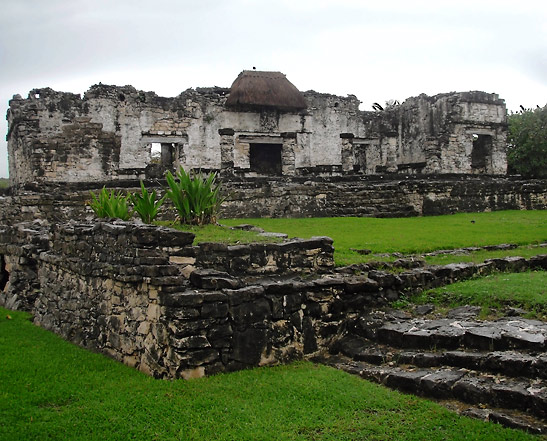
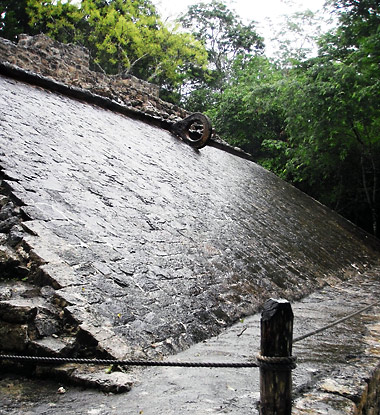
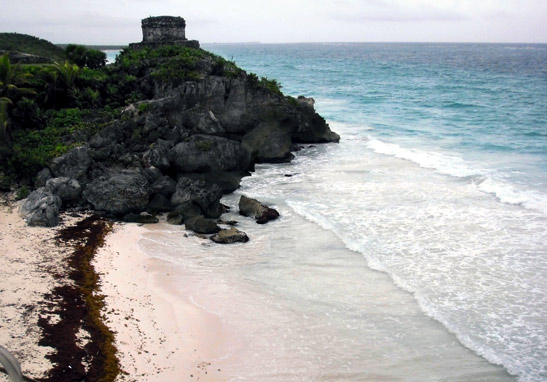
The ruins at Coba also include the famous Maya ball courts, replete with stone hoops. For sport, the Maya ball game didn't allow them to use their hands. They had to manipulate the ball through the hoop by hitting it with their hips and shoulders. Pieces of these ancient courts remain. The rest is ruins. In Tulum, by contrast, the architecture still comes into view, despite the ruins. In many cases, much of the original framework remains for the swarms of tourists to view. Standing on the famous cliff where the Spanish might first have landed, one can bring every component of history into perspective.
Xavier de Maria y Campos, the artist behind the Pyramid of Positive Thinking, says there will be no apocalypse after December 21, 2012. Instead, the Maya have identified that date as the moment when we reach the end of the 13th Baktun of the twenty-two-thousand-year-long count in which time as energy actually comes to a stop but only to restart or to be reborn again. His pyramid will be a metallic structure with alternating layers of the plastic bottles and soil containing regional plant seeds. Over time, plants will sprout, covering the faces of the pyramid. He claims the cosmic codes encrypted in the sacred geometry of the pyramid will enable the positive thoughts inside the bottles to become a powerful generator of positive energy, and thus reality. After contributing two optimistic thoughts for the pyramid project, I went to the beach and washed away all negative energy. At least for the time being.
Related Articles: |
 omewhere inside the Hacienda Tres Rios Resort near
 Let Gary know what you think about his traveling adventure.
Your tea adventures are especially interesting because I've always associated tea with British etiquette or a bevy of women wearing dainty victorian costumes and sipping tea with their little pinky sticking out. To see Tea from a man's perspective brings new light in a man's psyche. I've been among the many silent admirers of your writings for a long time here at Traveling Boy. Thanks for your very interesting perspectives about your travels. Keep it up! --- Rodger, B. of Whittier, CA, USA
|

|
| ||||
|
| ||||
|
| ||||
|
| ||||











This site is designed and maintained by WYNK Marketing. Send all technical issues to: support@wynkmarketing.com

|